Review
ElevenLabs Studio Review: Is It Worth It for Long-Form Audio?
A research-based ElevenLabs Studio review covering narration, timeline editing, export quality, credits, and the trade-offs for courses and audiobooks.
PrimeReview may earn a commission when you purchase through links on this page, at no extra cost to you. Read our affiliate disclosure.
At a glance
ElevenLabs Studio
- Brand
- ElevenLabs
- Product type
- SaaS
- Best for
- Course creators revising lessons over time, Authors organizing narration into chapters, Small production teams combining narration with music or video
- Pricing
- ElevenLabs lists Free, Starter, and Creator plans. Prices are in USD before taxes; billing periods have different payment conditions.
Table of contents
The short answer
Quick Verdict
ElevenLabs Studio is worth shortlisting for recurring scripted audio when chapter organization and selective revisions matter. Its documented workflow is appealing for courses and audiobooks, but generation costs and plan-dependent exports deserve a small pilot before a full production commitment.
Key information
- Starting price
- $6/month, monthly billing
- Free plan
- Available
- Best for
- Course creators revising lessons over time, Authors organizing narration into chapters, Small production teams combining narration with music or video
Pros and cons
Pros
- The Studio documentation describes chapter organization and paragraph-level generation history.
- Narration, music, and sound effects can be arranged on the documented timeline.
- A script-first workflow may reduce the effort of maintaining recurring audio projects.
Cons
- Text or voice changes can require a new paid generation.
- A WAV export on a lower tier is not necessarily sourced from lossless audio.
- Studio Agent chat and generated media can consume credits separately.
Cost and plans
Pricing overview
ElevenLabs lists Free, Starter, and Creator plans. Prices are in USD before taxes; billing periods have different payment conditions.
Starting price: $6/month, monthly billing
| Plan | Price | Details |
|---|---|---|
| Free | $0/month | The pricing page lists 10,000 monthly credits and 3 Studio projects; use it to assess the workflow. |
| Starter | $6/month | Monthly list price in USD before taxes. The vendor lists 30,000 credits, 20 Studio projects, and a commercial license. |
| Creator | $22/month | Monthly list price in USD before taxes. The vendor lists 121,000 credits; check the selected billing period and renewal terms. |
Annual equivalent prices are separate from monthly list prices. Confirm renewal terms and your selected billing period.
The verdict for a recurring audio workflow
An audiobook chapter or training lesson rarely stays finished after the first export. A name changes, a sentence needs a calmer delivery, or the next lesson must sound consistent with the previous one. That revision work is the most useful lens for reviewing ElevenLabs Studio.
Our editorial assessment is that Studio deserves a place on a creator’s shortlist when narration is a continuing project. The case is weaker for an occasional sentence that can be generated and assembled in an editor you already know. Buying a larger workspace only helps if its organization saves effort on your ordinary work.
This review uses official documentation. It is not a listening benchmark or a report from a paid-account trial. The images are vendor documentation screenshots, rather than evidence of our own production session. For the broader platform, see our ElevenLabs overview.
What Studio adds to text to speech
The Studio guide describes audio and video projects with script editing and a timeline. For an audio producer, the important distinction is the project structure: individual passages can be revised while chapters provide a larger organizing unit. A voice generator alone supplies audio; a project workspace helps keep track of where that audio belongs.
Consider a course with a recurring introduction, several lessons, and a closing exercise. Put each lesson in a separate chapter and keep the introduction as an approved passage. When a product term changes, review the affected lesson rather than casually regenerating the whole course. This is a proposed workflow, not a measured saving from Studio.
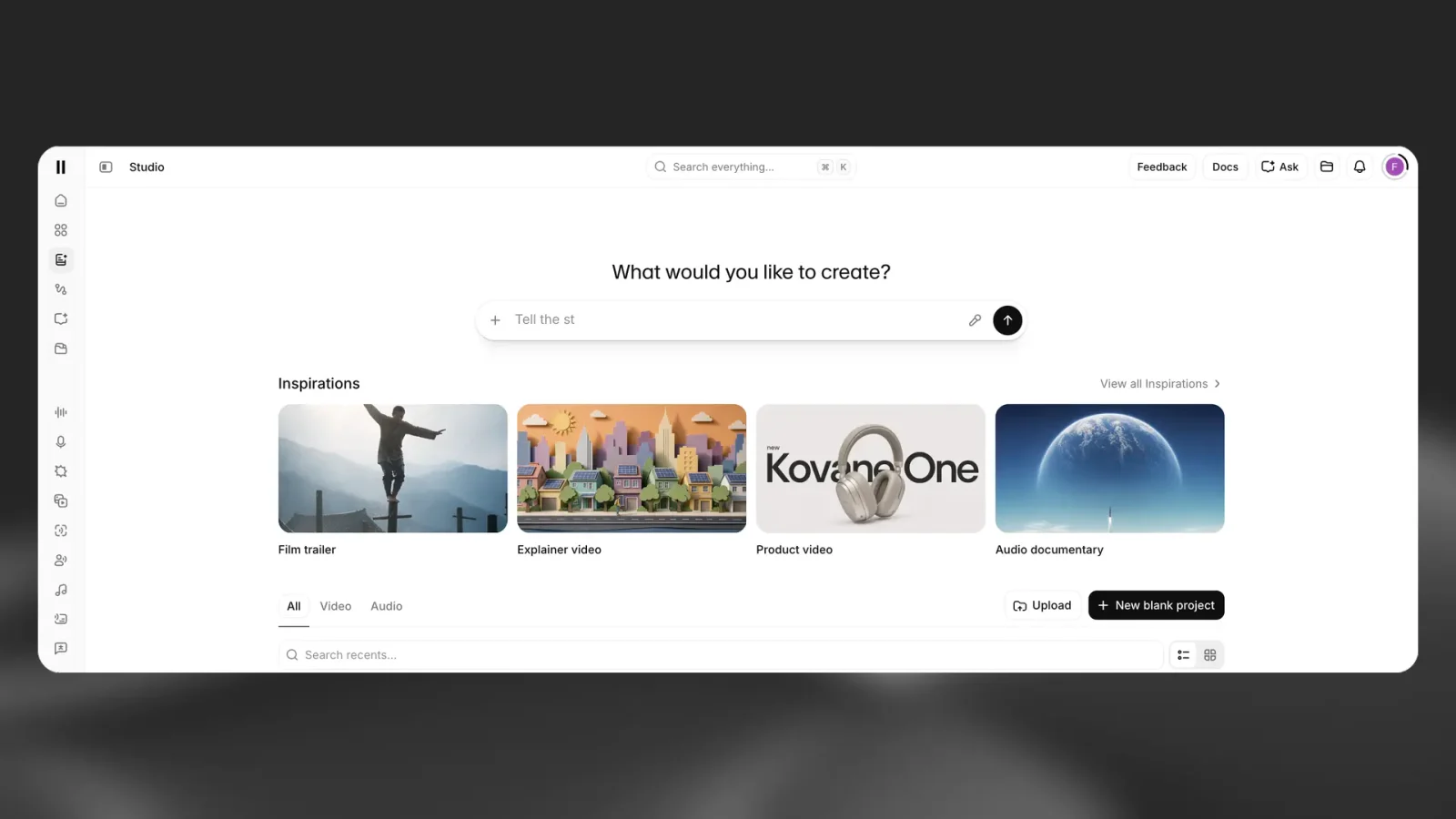
The header image shows Studio’s prompt bar and example projects in the official documentation. It illustrates the starting point; it does not establish how quickly a new user will learn the workspace.
Revisions are the feature to evaluate first
According to the guide, Studio keeps narration generation history at paragraph level. That makes it possible to compare earlier generated versions instead of assuming the newest take is the one to keep. The same guide distinguishes narration history from imported media, which is an important boundary for anyone expecting a complete project versioning system.
Changing text or voice can require generation again. A short correction can therefore have both an editorial cost and a usage cost. Keep a clean approved script, group related corrections, and avoid making isolated wording changes after every listen. Listen to the joins around a revised paragraph as well as the paragraph itself: a correct sentence can still have a noticeably different rhythm.
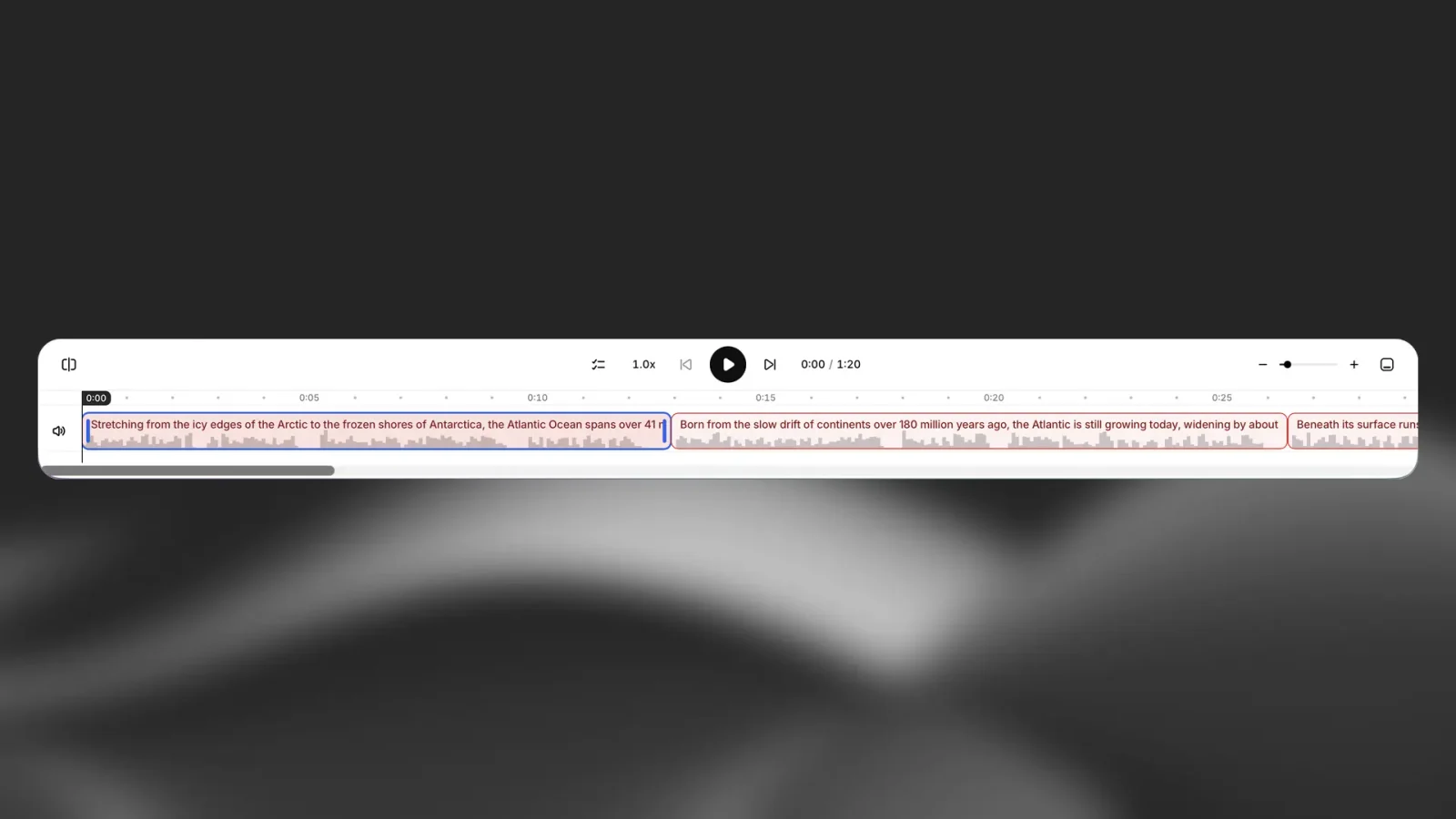
Official ElevenLabs documentation image: the Studio timeline, illustrating narration divided into editable segments.
Timing control matters more than a dramatic demo
The documented timeline lets users arrange narration with music and sound effects. Our view is that this is most valuable when timing has a clear purpose: space for a learner to inspect a diagram, a pause before an exercise, or a transition between chapters.
It is still necessary to listen to the full export. A music bed that sounds quiet on speakers can mask consonants on a phone. An enthusiastic line that works in isolation may clash with an instructional passage. Evaluate at the listener’s likely playback volume, and keep an unaccompanied narration version so that a mix problem does not force a new speech generation.
For projects that depend on a performer’s individual interpretation, first compare the synthetic workflow with a human recording. Emotional direction and the right to use a particular voice are separate decisions from whether the editor has suitable tracks.
Plan selection: separate price, credits, and rights
The official pricing page lists monthly USD prices of Free at $0, Starter at $6, and Creator at $22 before taxes. These are monthly list prices. The pricing page lists annual billing equivalents with different payment and renewal conditions. Do not read an annual monthly equivalent as a cancellable monthly bill.
The vendor lists a commercial license starting on Starter. That does not settle rights to an uploaded script, music recording, or another person’s voice. Before client work, document who may approve a voice, where the result may be distributed, and who retains the final script and audio files.
Credits also deserve their own budget. Studio Agent chat and generated media can draw separate charges, according to the guide. A conversation that plans a project is not the same activity as generating its narration or video. Estimate the ordinary month, then allow room for corrections; see the worked scenario in our credit planning article.
A WAV file can still come from a compressed source
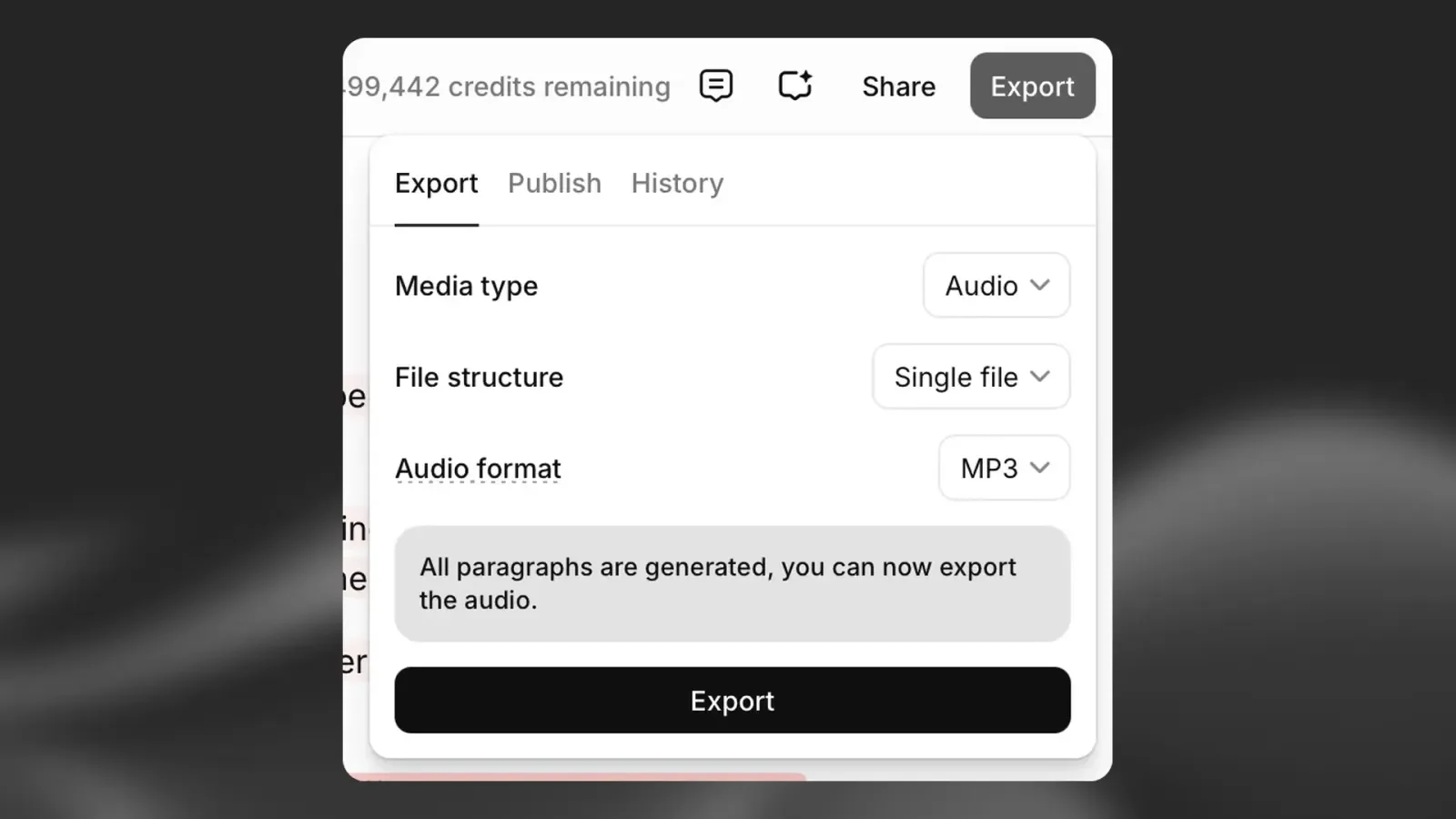
Official ElevenLabs Studio export illustration. Check the plan’s source quality as well as the file format selected.
The Studio documentation says that Free, Starter, and Creator offer 128 kbps MP3 or WAV generated from a 128 kbps source. Higher tiers list different source-quality options. This distinction can matter to an audiobook distributor or a client with delivery specifications: converting a compressed source into WAV does not recreate information already discarded.
Ask the destination for its requirements before paying for a higher tier. Record the required format, sample rate, bit depth where relevant, loudness, and whether post-processing is permitted. Then verify the actual exported file. A plan name alone is not a delivery specification.
A useful pilot before a full book or course
Choose one passage with a difficult name, one explanation containing numbers, and one transition between sections. Keep them representative of the project rather than selecting only easy prose. Our script preparation guide shows how to separate spoken copy from production notes.
Track what needed correction, which settings you changed, the credits charged, and the time spent reviewing. Keep an approved reference clip to compare later chapters. If the result needs repeated trial and error, count that effort in the purchase decision rather than treating generation time as the whole workflow.
Studio looks most promising when its project structure matches work you already need to maintain. Choose a plan after the pilot confirms the workflow, rights, and export requirements. The available documentation supports that shortlist decision; it does not prove that Studio will sound better or cost less for every creator.
Sources and review scope
- ElevenCreative Studio documentation — project editing, generation behavior, and export distinctions.
- ElevenLabs pricing — plans and billing conditions.
- Text-to-speech documentation — generation and commercial-use context.
Common questions
Frequently asked questions
Is ElevenLabs Studio good for audiobooks?
Its documented chapters and paragraph editing make it a plausible option for scripted long-form work. Test a representative chapter, including names and dialogue, and check the intended distributor’s submission requirements before producing the whole book.
Does exporting WAV guarantee lossless source quality?
No. The Studio documentation says Free, Starter, and Creator WAV exports are generated from a 128 kbps source. A file extension alone does not establish the quality of the original audio.
Is this a hands-on ElevenLabs review?
This is a research-based editorial review of official documentation. It does not report paid-account testing, listening scores, or measured production savings.