Comparison
ElevenLabs vs. Murf, Descript & OpenAI: Which Workflow Fits?
Compare ElevenLabs with Murf, Descript, and OpenAI for scripted narration, recorded-audio repair, and API work, with practical selection criteria.
PrimeReview may earn a commission when you purchase through links on this page, at no extra cost to you. Read our affiliate disclosure.
The short answer
Quick Answer
Start with the source material. Compare ElevenLabs and Murf for a written script, Descript for repairing recorded speech, and OpenAI for an application that needs a speech API. These are workflow recommendations based on documentation, rather than a universal voice-quality ranking.
ElevenLabsShortlist ElevenLabs for recurring audio projects and a broader voice toolkit.
MurfShortlist Murf for narration with pronunciation and presentation-oriented controls.
ElevenLabs
Best for: Creators maintaining narrated projects or exploring a broader voice workflow.
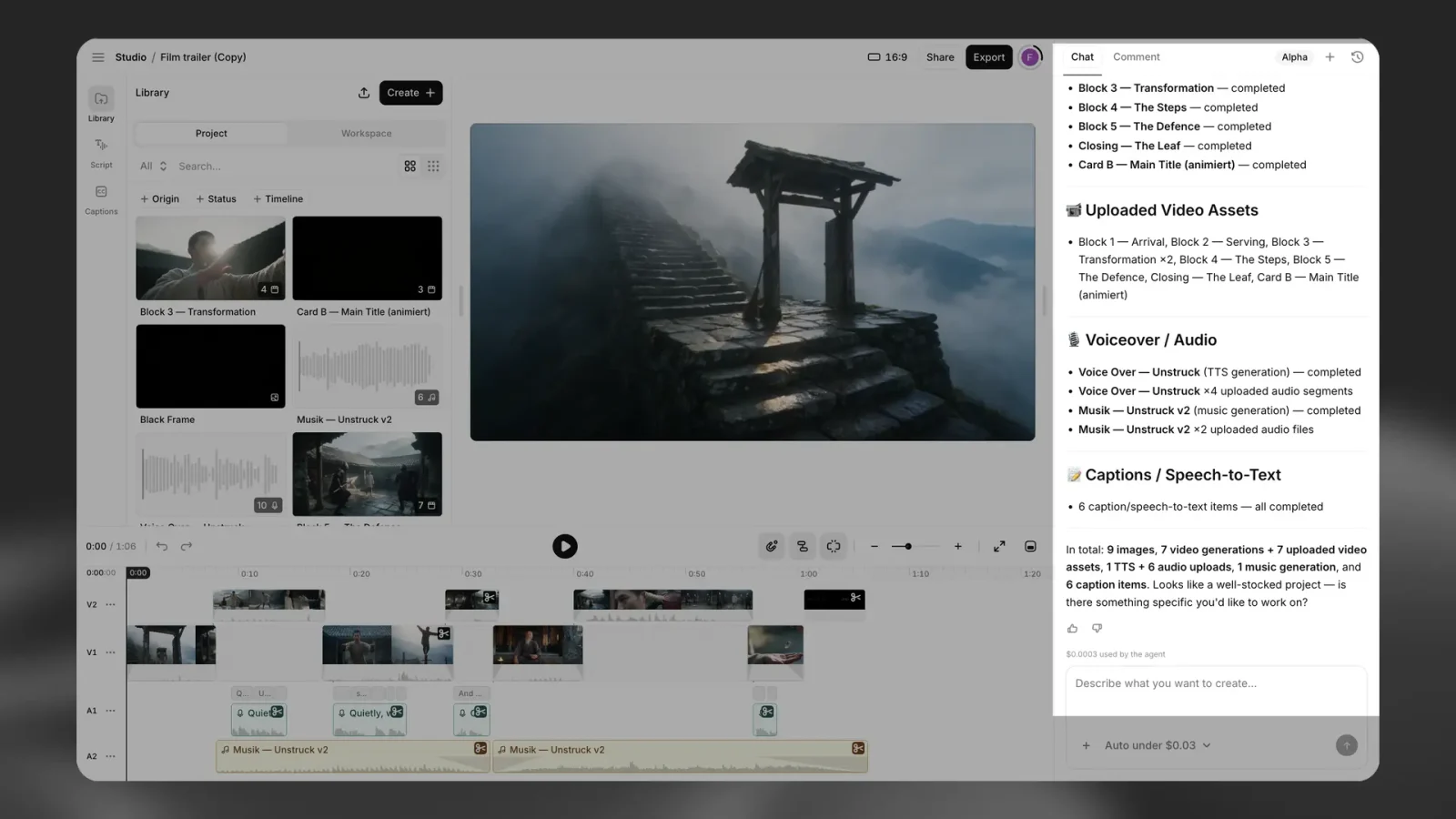
ElevenLabs documents Studio projects, narration editing, voice tools, and developer APIs. Our assessment is that it is a useful shortlist option when several audio tasks belong in one workflow.

Murf
Best for: Creators evaluating controlled voiceover production and presentation workflows.
Murf documents a Studio workflow with pronunciation and delivery controls, plus presentation integrations. Our assessment is that it merits a direct trial for educational or business narration.
Table of contents
Side by side
Quick Comparison
| Criteria | ElevenLabs | Murf |
|---|---|---|
| Project starting point | The Studio guide describes prompt-led projects and uploaded scripts or documents. | The Murf TTS page describes generating voiceovers from written material. |
| Revising pronunciation | ElevenLabs documents pronunciation rules with support that depends on the selected model. | Murf advertises a custom pronunciation library and delivery controls. |
| Working beyond narration | The Studio guide describes narration alongside music, sound effects, and video tracks. | Murf lists Studio integrations with Canva, PowerPoint, and Captivate. |
| Budget comparison | The pricing page describes shared credits across product activities. | Check the selected Studio plan for generation, downloads, and commercial-use allowances. |
| Evidence for a quality winnerTie | No matched listening test was conducted for this article. | No matched listening test was conducted for this article. |
Project starting point
- ElevenLabs
- The Studio guide describes prompt-led projects and uploaded scripts or documents.
- Murf
- The Murf TTS page describes generating voiceovers from written material.
Revising pronunciation
- ElevenLabs
- ElevenLabs documents pronunciation rules with support that depends on the selected model.
- Murf
- Murf advertises a custom pronunciation library and delivery controls.
Working beyond narration
- ElevenLabs
- The Studio guide describes narration alongside music, sound effects, and video tracks.
- Murf
- Murf lists Studio integrations with Canva, PowerPoint, and Captivate.
Budget comparison
- ElevenLabs
- The pricing page describes shared credits across product activities.
- Murf
- Check the selected Studio plan for generation, downloads, and commercial-use allowances.
Evidence for a quality winner
Tie- ElevenLabs
- No matched listening test was conducted for this article.
- Murf
- No matched listening test was conducted for this article.
Project starting point
A script-based pilot is the useful direct comparison. Descript and OpenAI serve different starting points, discussed below.
Revising pronunciation
Use your actual names and abbreviations. The existence of a control does not establish which product needs less correction.
Working beyond narration
Compare the part that connects to your existing production process; avoid paying for overlapping editors.
Budget comparison
A subscription headline is insufficient. Price the same deliverable, revision workload, and distribution rights.
Evidence for a quality winner
TieRecommendations here concern documented workflow fit. No voice-quality or speed winner is assigned.
Which should you choose?
Choose based on your needs
Choose ElevenLabs if...
- You want to assess chapter-based narration and a timeline in Studio.
- You plan to produce several types of generated audio.
- You can budget revisions and verify the selected export tier.
Choose Murf if...
- You want to evaluate pronunciation and delivery controls for scripts.
- Presentation integrations are relevant to your existing workflow.
- A sample lesson is a better purchase test than a broad feature list.
Bottom line
Final Verdict
ElevenLabs and Murf are the closest script-to-narration comparison here. Descript belongs in the decision when the job starts with recorded speech; OpenAI belongs when software integration is central. Choose after completing the same representative task in the relevant candidates.
More context
Additional buying considerations
Four tools, four possible production problems
The closest alternative to a voice generator is not always another voice generator. A producer correcting an interview has a different problem from a developer adding spoken output to an application. This comparison puts ElevenLabs and Murf side by side for written narration, then explains when Descript or OpenAI should enter the shortlist.
The analysis uses official pages. There was no paid-account trial or controlled listening test. Recommendations are editorial judgments about the documented workflows. Vendor demo images below illustrate those workflows and are not results from our own tests.
| Tool | Most relevant starting point | What to establish in a pilot |
|---|---|---|
| ElevenLabs | A script or recurring audio project | Revision effort, credit consumption, and export tier |
| Murf | Written narration for a lesson or presentation | Pronunciation control and fit with your presentation tools |
| Descript | Existing recorded speech | Whether a repair preserves the surrounding delivery |
| OpenAI | An application needing generated speech | Documented API workflow, development effort, and maintenance requirements |
ElevenLabs vs. Murf: the closest direct comparison
For a training video, start with the same script and the same intended audience. ElevenLabs’ Studio guide describes a project workspace that brings narration and other media onto a timeline. Murf’s TTS page and homepage describe a voiceover workflow with pronunciation and delivery controls, alongside presentation integrations.
Those descriptions suggest different evaluation priorities, not exclusive capabilities. An author maintaining chapters may place more weight on project organization. A trainer building slides may care more about moving narration into an existing presentation process. Neither feature list establishes how convincing a particular voice will sound to the audience.
Official Murf product visual showing voice-profile portraits. Voice selection is part of the narration workflow; this illustration is not a pronunciation test or an account screenshot from this comparison.
For the pilot, use a person’s name, a product abbreviation, a price spoken in context, and a sentence that needs emphasis. Judge whether the message survives and how much editing remains. Keep voice selection and revision effort in the record. A good first take on an easy sentence is weaker evidence than a complete lesson that remains understandable after corrections.
Where Descript belongs in the decision
Descript’s Regenerate page is about repairing recorded speech: smoothing mismatched edits or regenerating a passage to fit surrounding audio. That makes it relevant when the original recording is valuable and the job is to repair it.
Imagine an interview where a speaker says a product name incorrectly. Replacing the whole interview with synthetic narration changes the production. A targeted repair is a different objective. Assess whether the corrected passage preserves the speaker’s delivery and whether the speaker has approved the change.
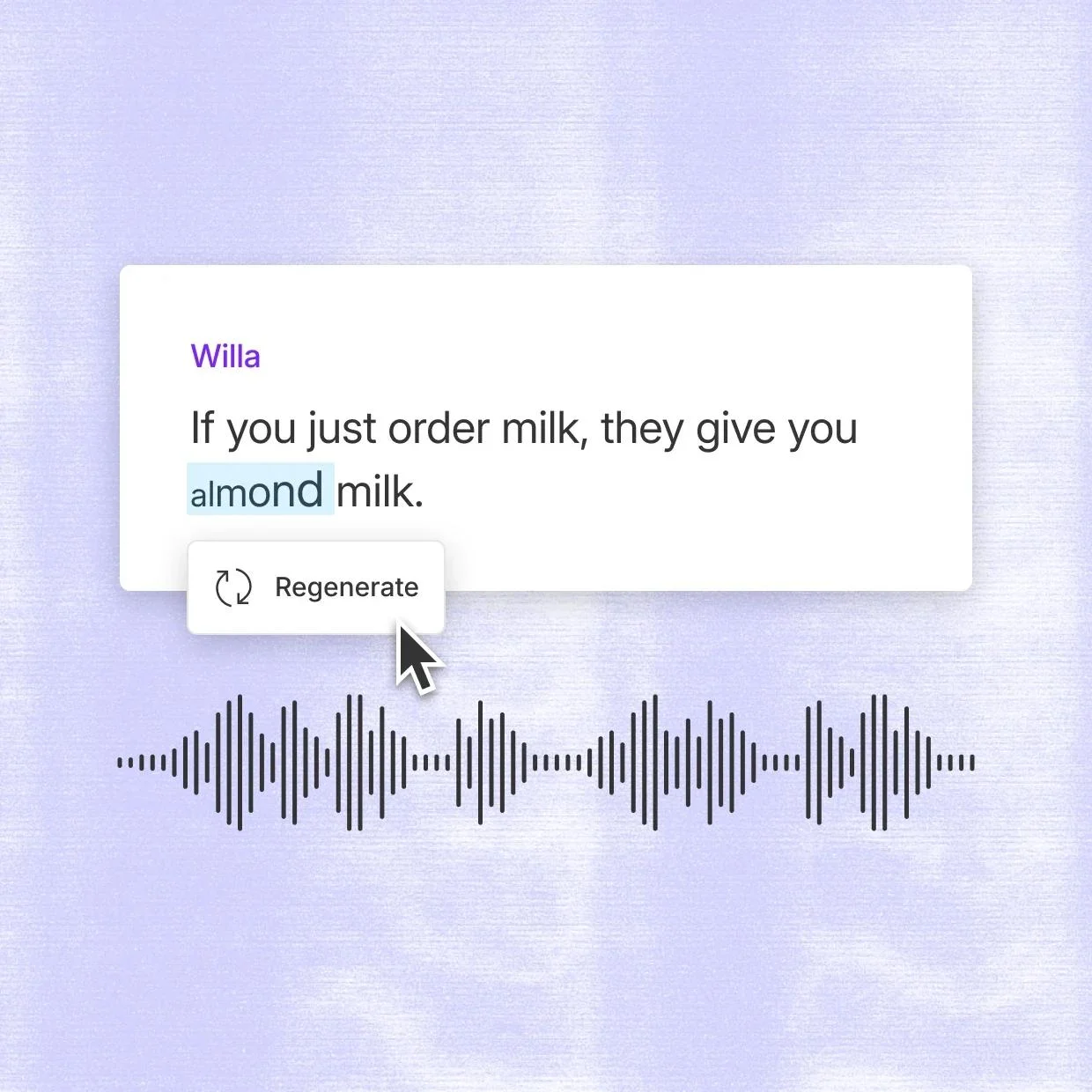
Official Descript Regenerate illustration, used to show the recorded-audio repair context. The image does not demonstrate repair quality on our material.
Our assessment is that Descript should enter the shortlist when the source recording is central to the project. For a new audiobook with no recording, begin by comparing script-to-speech workflows instead. Confirm the selected account’s voice authorization, generation, and export conditions before planning a client repair project.
OpenAI: evaluate the API workflow and maintenance
OpenAI’s text-to-speech documentation describes an API approach. An application must handle requests, files, errors, and the user experience around playback. This can suit a team with an existing software product; a solo narrator should budget for building project management and editing around the API.
Review the supported models and API workflow before selecting an implementation. An endpoint or model name copied from another project may not fit your application. Confirm how requests, streaming, output storage, and failure handling will work together using the official guide.
A short code example is not a complete production plan. Ask which supported workflow the application will use, how audio will be reviewed, and who will maintain it. OpenAI’s documentation also requires clear disclosure that the generated voice is AI-produced. Treat that requirement as part of the product experience.
How to compare cost without mixing units
Use one deliverable: for example, a narrated training lesson with a fixed script and one correction pass. Write down the required output format, commercial use, language, and whether the source is a script or a recording. Then price the tasks needed to finish it.
For ElevenLabs, the pricing page describes credits shared across products. A speech allowance should not be assumed to cover unrelated media or Agent activity without additional usage. For Murf and Descript, check the selected plan’s generation and download conditions. For an API, budget for development and maintenance alongside metered generation.
We have not normalized the competitors into a cheapest-per-minute ranking: that would require matched usage conditions and verified plan terms. The useful calculation is cost per approved deliverable, including rejected takes and manual work. Our ElevenLabs cost guide provides a transparent planning example.
A practical decision procedure
- Classify the input as a written script, a valuable recording, or an application request.
- Select the two candidates that fit that input and check the relevant account allowances.
- Complete the same short task, keeping names, numbers, language, and delivery requirements fixed.
- Record corrections, time spent reviewing, usage charged, and the quality of the final export.
- Keep the tool that solves the recurring job without creating a larger editing or maintenance burden.
If ElevenLabs fits the first stage, our Studio review explains the project and export trade-offs. If script corrections dominate the pilot, improve the spoken copy before assuming another generator will solve the problem.
Sources and image credits
- ElevenLabs Studio and pricing.
- Murf TTS and Murf product overview.
- Descript Regenerate.
- OpenAI TTS guide for API workflow requirements.
The header is an official ElevenLabs Studio Agent screenshot. All product images remain attributed to their respective vendors. Documentation establishes available controls; the recommendations above are our editorial interpretation of their fit.
Common questions
Frequently asked questions
Which ElevenLabs alternative is best?
It depends on the job. Our editorial shortlist is Murf for scripted voiceover, Descript for recorded-audio repair, and OpenAI for software development. This article does not establish an overall voice-quality winner.
Is OpenAI TTS a direct replacement for Studio?
An API needs application code and project handling. Review the supported workflow in OpenAI’s documentation before choosing an endpoint.
Should I subscribe to several voice tools?
Only if a second tool solves a demonstrated gap. Price one complete deliverable and record what still needs manual work before adding another subscription.