Article
How to Fix ElevenLabs Pronunciation: Names, Acronyms, and Numbers
Fix names, acronyms, and ambiguous numbers in ElevenLabs using a pronunciation reference, supported dictionary rules, and a focused verification workflow.
Overview
Resolve the intended reading first, then use a correction method supported by the selected model. A reusable pronunciation reference is more reliable than repeatedly guessing at spellings.
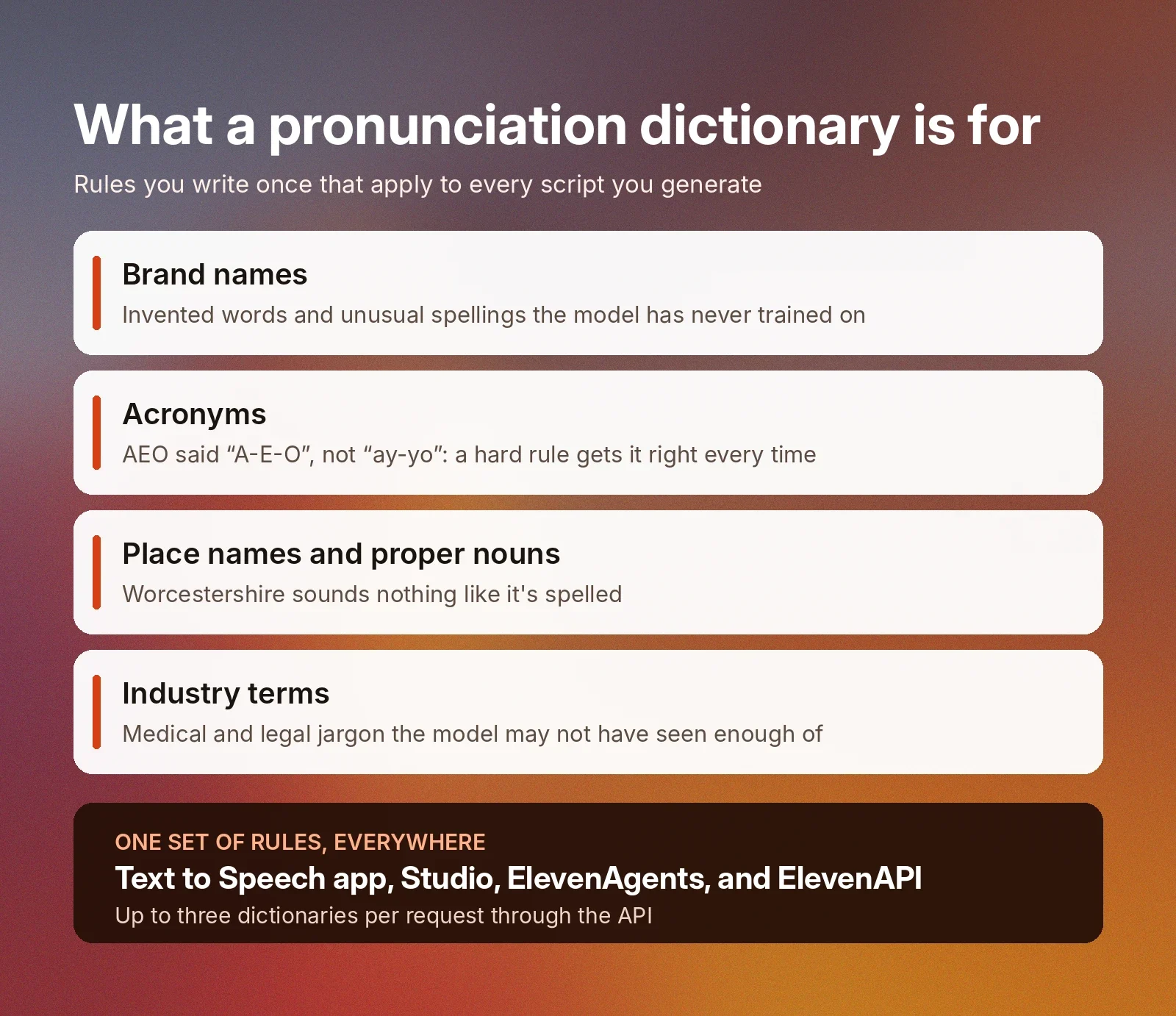
Table of contents
Quick explanation
In Short
- Confirm the intended pronunciation with an appropriate reference.
- Distinguish alias rules from phoneme rules.
- Test the correction inside a complete sentence and check captions separately.
Establish the right sound before changing settings
When a generated voice mispronounces a name, changing voices at random can produce a different mistake. First decide what the word should sound like. Ask the person or brand owner where possible, or use a suitable language reference. Keep a short approved recording or a written pronunciation note with the script.
This guide uses ElevenLabs’ pronunciation dictionary article and Studio documentation. The workflow recommendations are editorial guidance; the example corrections are not measured outputs from a particular voice.
Identify the type of error
| Problem | First question | Useful starting correction |
|---|---|---|
| Person or brand name | What reading has the owner approved? | A supported alias or phoneme rule |
| Acronym | Is it a word or separate letters? | An explicit spoken expansion |
| Number | Is it a date, amount, code, or quantity? | Rewrite the intended spoken form |
| Mixed-language phrase | Which language and regional reading is intended? | Review the voice and model choice, then test in context |
For example, a product code may need individual digits even when the same digits would normally be read as a year. Keep the exact written code in the reference script, and create a separate spoken form for synthesis. This makes the correction inspectable instead of hiding it inside an arbitrary spelling change.
Choose between an alias and a phoneme rule
ElevenLabs documents alias rules as text replacements and phoneme rules as a way to specify speech sounds. An alias can be easier to maintain when a clear respelling or expansion works. A phoneme rule may be more precise, but the transcription must be correct and the model guide must document the method.
Do not copy a phonetic transcription without checking its language and accent. A notation that accurately describes one regional pronunciation may be wrong for the audience you intend. If no one on the team can verify the transcription, start from an approved recording and ask a qualified speaker to review the result.
The header image is an official ElevenLabs illustration of dictionary use cases. It introduces the purpose of these rules; it is not a screenshot demonstrating that a correction succeeded on our script.
Check model support before using tags
Pronunciation methods are model-specific. The official guide says Eleven v4 supports dictionary phoneme rules and inline IPA, while SSML phoneme tags are not its pronunciation mechanism. Older-model instructions can therefore be the wrong recipe for a newer project.
Record the model used in the project before adding notation. Check its model guide and avoid combining several correction approaches at once. If a phonetic respelling, inline instruction, and dictionary rule all affect the same word, it becomes harder to know which change produced the final reading.
Apply the correction to a short sentence
Use a complete sentence from the project, with the target word in its surrounding context. Keep the voice and model fixed. Add one correction, generate the passage, and listen for the target word and the rhythm around it.
If the word is fixed but the sentence sounds fragmented, refine the correction before applying it throughout the project. Listen at an ordinary playback speed. A result that is understandable only after repeated listening still needs work for an unfamiliar audience.
For recurring names, store the accepted correction in the project’s pronunciation reference. Record the spelling, intended sound, rule type, language, and reviewer approval. Cover relevant capitalization variants where the dictionary requires them; the official guide says its rules are case-sensitive.
Review captions and written copy separately
A synthesis workaround should not damage the written material. If you replace a brand name with a phonetic spelling in the narration input, keep the correct brand spelling in captions, titles, and transcripts. Review any automatically derived text before export.
This is especially important for instructional content. Viewers may need to search for the exact product name or type a command shown on screen. The spoken explanation and the written label can serve different purposes while remaining consistent about the underlying term.
Recheck after changing a voice or model
An approved correction belongs to a particular production context. Changing a voice, model, or language can alter delivery, so listen again to a short reference passage before regenerating the complete lesson or book. Retain an approved clip for comparison rather than relying on memory.
Resolve the recurring words before the expensive production pass. Our script guide explains how to keep spoken copy and production notes separate, and the credit planning guide shows why charged revisions belong in the budget.
Common questions
Frequently asked questions
Why does ElevenLabs pronounce my brand name incorrectly?
An unusual spelling or an ambiguous name may not produce the reading you intend. Establish the approved reading, then test a supported alias or phoneme rule in context.
Do SSML tags work with every ElevenLabs model?
No. The official pronunciation guide describes model-specific support. It says Eleven v4 uses other pronunciation controls rather than SSML phoneme tags. Confirm the exact model before choosing notation.
Should I change captions to a phonetic spelling?
Usually keep the correct written name in captions and display copy. A phonetic workaround used for synthesis should not silently become the public spelling.