Comparison
QuillBot vs. Grammarly for Non-Native English Writers
Compare QuillBot and Grammarly for revising English emails, proposals, and longer drafts, with a focus on rewriting, tone, and learning from edits.
PrimeReview may earn a commission when you purchase through links on this page, at no extra cost to you. Read our affiliate disclosure.
The short answer
Quick Answer
Our editorial assessment is to start with the kind of help you need: QuillBot may suit exploring alternative phrasing, while Grammarly may suit reviewing errors and tone in an existing message. Both cover overlapping jobs. This is a comparison of documented workflows, not a head-to-head accuracy ranking.
QuillBotConsider it when your main question is how else to phrase a sentence or paragraph.
GrammarlyConsider it when your main question is what to correct and how the message may sound.

QuillBot
Best for: Writers exploring alternative phrasing for a passage they have already drafted.
QuillBot documents a paraphrasing workflow with modes and word-level alternatives, alongside grammar tools. Its controls may suit deliberate sentence revision.
Grammarly
Best for: Writers who want to examine grammar and tone while preparing everyday messages.
Grammarly lists grammar and spelling help and tone visibility on Free, with additional rewriting and tone controls on Pro. Those distinctions may suit a correction-first workflow.
Table of contents
Side by side
Quick Comparison
| Criteria | QuillBot | Grammarly |
|---|---|---|
| Primary editing task | QuillBot documents modes and word alternatives for paraphrasing. | Grammarly lists spelling, grammar and tone assistance in its plan comparison. |
| Tone and phrasing | QuillBot describes rewriting modes for different styles. | Grammarly lists tone visibility on Free and tone adjustment on Pro. |
| Starting without paymentTie | QuillBot lists a Free tier with restricted paraphrasing access. | Grammarly lists a Free tier; its plan page separates basic checks from Pro features. |
| Learning from an edit | Alternative phrasings provide sentences you can compare with your original. | Correction and tone suggestions provide changes you can inspect before accepting. |
| Preserving the intended claimTie | Mode and synonym choices still need a meaning check. | A correction or rewrite still needs a meaning check. |
Primary editing task
- QuillBot
- QuillBot documents modes and word alternatives for paraphrasing.
- Grammarly
- Grammarly lists spelling, grammar and tone assistance in its plan comparison.
Tone and phrasing
- QuillBot
- QuillBot describes rewriting modes for different styles.
- Grammarly
- Grammarly lists tone visibility on Free and tone adjustment on Pro.
Starting without payment
Tie- QuillBot
- QuillBot lists a Free tier with restricted paraphrasing access.
- Grammarly
- Grammarly lists a Free tier; its plan page separates basic checks from Pro features.
Learning from an edit
- QuillBot
- Alternative phrasings provide sentences you can compare with your original.
- Grammarly
- Correction and tone suggestions provide changes you can inspect before accepting.
Preserving the intended claim
Tie- QuillBot
- Mode and synonym choices still need a meaning check.
- Grammarly
- A correction or rewrite still needs a meaning check.
Key details
Pricing & Plans
QuillBot
- Free plan
- Available
Grammarly
- Free plan
- Available
Primary editing task
Start from a real task: restructuring a paragraph and checking a short client email call for different kinds of intervention.
Tone and phrasing
Either approach still needs your judgment about the reader, relationship and intended level of formality.
Starting without payment
TieTry the part of the workflow available to you before paying. A free-tier comparison cannot establish the behavior of every paid feature.
Learning from an edit
Neither documented feature set establishes which product teaches better. Keep a record of the reason for each useful change.
Preserving the intended claim
TieUse the same checklist for dates, scope, certainty and responsibility. We have not measured a quality winner.
Which should you choose?
Choose based on your needs
Choose QuillBot if...
- You want to inspect several ways of expressing an existing idea.
- You prefer revising one coherent passage at a time.
- You are prepared to review the meaning of synonym and mode changes.
Choose Grammarly if...
- You mainly want to inspect spelling, grammar and tone in routine messages.
- You prefer starting from a correction rather than a broad rewrite.
- You will check that the selected plan covers the exact writing features you need.
Bottom line
Final Verdict
No single overall winner
Choose a starting point by editing task, then evaluate it with your own non-confidential writing. QuillBot may fit a deliberate rewriting workflow; Grammarly may fit a correction-and-tone workflow. There is insufficient evidence here to declare either more accurate for all non-native English writers.
More context
Additional buying considerations
A useful comparison starts with the job
“Help me write better English” can mean several different things. You may know exactly what you mean but be unsure about grammar. You may have a correct sentence that feels too abrupt. Or you may need a different structure for a dense paragraph.
Those are different tasks, so this comparison does not treat every feature as a point in a universal score. The recommendations are editorial judgments based on official product descriptions checked on November 5, 2026. No matched-sample correction benchmark or paid-account trial was performed.
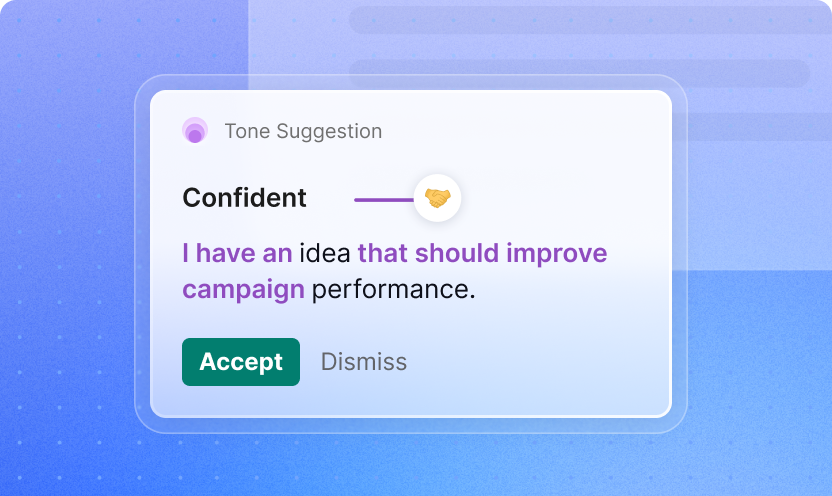
The blue header image is an official Grammarly tone-suggestion illustration. The QuillBot image in the product cards is also vendor-supplied. Neither is a screenshot of a test conducted for this article.
Where the documented approaches overlap
QuillBot is not limited to rewriting, and Grammarly is not limited to spelling. Their official paraphraser documentation and plan comparison describe overlapping ways to revise English.
The distinction used here is a starting point for evaluation: exploring alternative phrasing versus inspecting corrections and tone. It is not an exclusive boundary between the products. For a broader account of QuillBot, see our existing review.
Three writing situations to compare yourself
A brief client email
Use an invented message with a request, a date, and a polite qualification. Ask whether the editing process helps you preserve all three. Do not judge the result only by how formal it sounds.
For example, “Could we review the draft on Thursday?” should not quietly become “We will approve the draft on Thursday.” The second sentence changes both the commitment and the activity. This is an editorial example, not an output attributed to either product.
A paragraph that needs restructuring
Choose a short explanation you wrote yourself. Look for a clearer order of ideas while keeping definitions and qualifications stable. A rewrite that removes repeated words but obscures the argument has not solved the problem.
Record which changes you would keep, which you would reject, and why. That record is more useful than counting every visible suggestion as a benefit.
A sentence you want to learn from
Pick a recurring issue such as articles, verb agreement, or polite requests. After reviewing a correction, explain it in your own words and write a second example without assistance.
If the change is unclear, check a reliable language reference or ask a qualified reviewer. Neither accepting a suggestion nor seeing an alternative sentence demonstrates that you understand the rule.
A fair evaluation needs the same conditions
Use the same original passages for both tools, and record the tier and settings available to you. If one product’s paid feature is unavailable, mark it as unassessed rather than treating the missing access as an incorrect answer.
| Record | What to write down |
|---|---|
| Intended message | The claim, request, or explanation that must survive |
| Access | Product, tier, mode, and date |
| Useful changes | Edits you would keep, with a reason |
| Meaning changes | Added promises, removed conditions, or altered technical terms |
| Final effort | What still needs manual review |
This is a proposed evaluation method for readers. It is not a description of testing already carried out by PrimeReview.
Compare subscriptions only after the workflow fits
Both vendors distinguish free access from paid features. Consult the current QuillBot plans and Grammarly plans for the exact entitlement you need. The product cards intentionally avoid comparing an annual monthly equivalent with an unclear billing basis.
Check the full charge, renewal period, and any trial conditions before committing. Our software subscription checklist covers those questions. If you need only one advanced feature for a short project, assess the commitment against that project’s duration.
Keep your own voice in the final version
A non-native English writer does not need every sentence to sound like a corporate announcement. Clear, direct language is often enough. Retain a phrase that is correct and natural for your reader even if an alternative is available.
For consequential work, give a fluent reviewer the original meaning as well as the revised English. That makes it easier to spot a sentence that reads well but no longer says what you intended.
Sources and imagery: official QuillBot Paraphraser, Premium and homepage pages; official Grammarly plans and homepage pages. Checked November 5, 2026. Recommendations concern workflow fit and do not claim measured superiority.
Common questions
Frequently asked questions
Is QuillBot or Grammarly more accurate?
This research-based comparison does not establish an accuracy winner. That would require a defined set of writing samples, comparable account access, and a documented scoring method.
Should a non-native English writer pay for both?
Not automatically. Identify which recurring task remains unresolved after trying one workflow. Two subscriptions may duplicate work and introduce conflicting suggestions.
Can either tool replace a fluent reviewer?
Do not assume that. A reviewer may need to assess context, technical meaning, cultural expectations, or commitments that are not settled by a grammar suggestion.