Buying Guide
How to Hire a Freelancer on Upwork: A Practical Buyer’s Guide
Hire on Upwork with a clear brief, relevant screening questions, a suitable contract, a paid pilot, and a practical handover checklist.
PrimeReview may earn a commission when you use qualifying links on this page, at no extra cost to you. Read our affiliate disclosure.
Start here
A successful first hire starts before the offer. Define an output you can review, choose a candidate with relevant evidence, and agree how work, revisions, and handover will be handled.

Table of contents
- Key Takeaways
- Buying Criteria
- 1. Define what you need to receive
- 2. Turn that output into a short brief
- 3. Post the job or search for talent
- 4. Shortlist by relevance, then interview
- 5. Choose the contract and confirm the total
- 6. Start with a limited paid commitment
- 7. Review work while the contract is active
- 8. Complete handover before expanding the work
- Common Mistakes
- Recommended Resources
- FAQ
The essentials
Key Takeaways
- Write acceptance criteria before collecting quotes
- Interview around a relevant work example
- Use a limited paid discovery step when the scope is uncertain
- Assign someone to review submissions and billing promptly
1. Define what you need to receive
Start with the output rather than a job title. “Need a marketer” leaves the provider guessing. “Audit the current email welcome sequence and deliver a prioritized revision plan” establishes a purchase that can be discussed.
Write what exists today, what should change, and how you will recognize completion. Identify one person who can approve the work. If several stakeholders need a say, resolve their priorities before inviting proposals.
This guide combines editorial hiring advice with Upwork’s documented workflow, checked on November 16, 2026. The examples are hypothetical planning aids, not completed PrimeReview hiring projects.
2. Turn that output into a short brief
Use the following structure before opening the job form:
| Brief field | Example for a landing-page assignment |
|---|---|
| Objective | Prepare a campaign page for a new service |
| Supplied materials | Approved copy, logo files, and existing design guidelines |
| Deliverables | One responsive page on staging and editable source files |
| Completion checks | Form sends correctly, approved content is present, and layouts are reviewed on agreed devices |
| Exclusions | No new brand identity, paid campaign setup, or ongoing maintenance |
| Review | One named approver returns consolidated feedback |
| Handover | Source files, deployment notes, and a list of dependencies |
If a completion check requires technical knowledge you do not have, involve a reviewer before hiring. Otherwise you may be unable to distinguish a convincing demo from a usable delivery.
3. Post the job or search for talent
Upwork’s hiring guide describes posting a job or searching profiles, then shortlisting, interviewing, and sending an offer. Choose the route that suits what you already know. A public brief may surface different approaches; direct search may help when the required specialization is clear.
Upwork’s job-post guide documents title, skills, scope, budget, and project description fields, plus an optional AI-generated draft. Check any generated text against your actual brief. Remove invented requirements and do not insert sensitive client material into a draft unnecessarily.
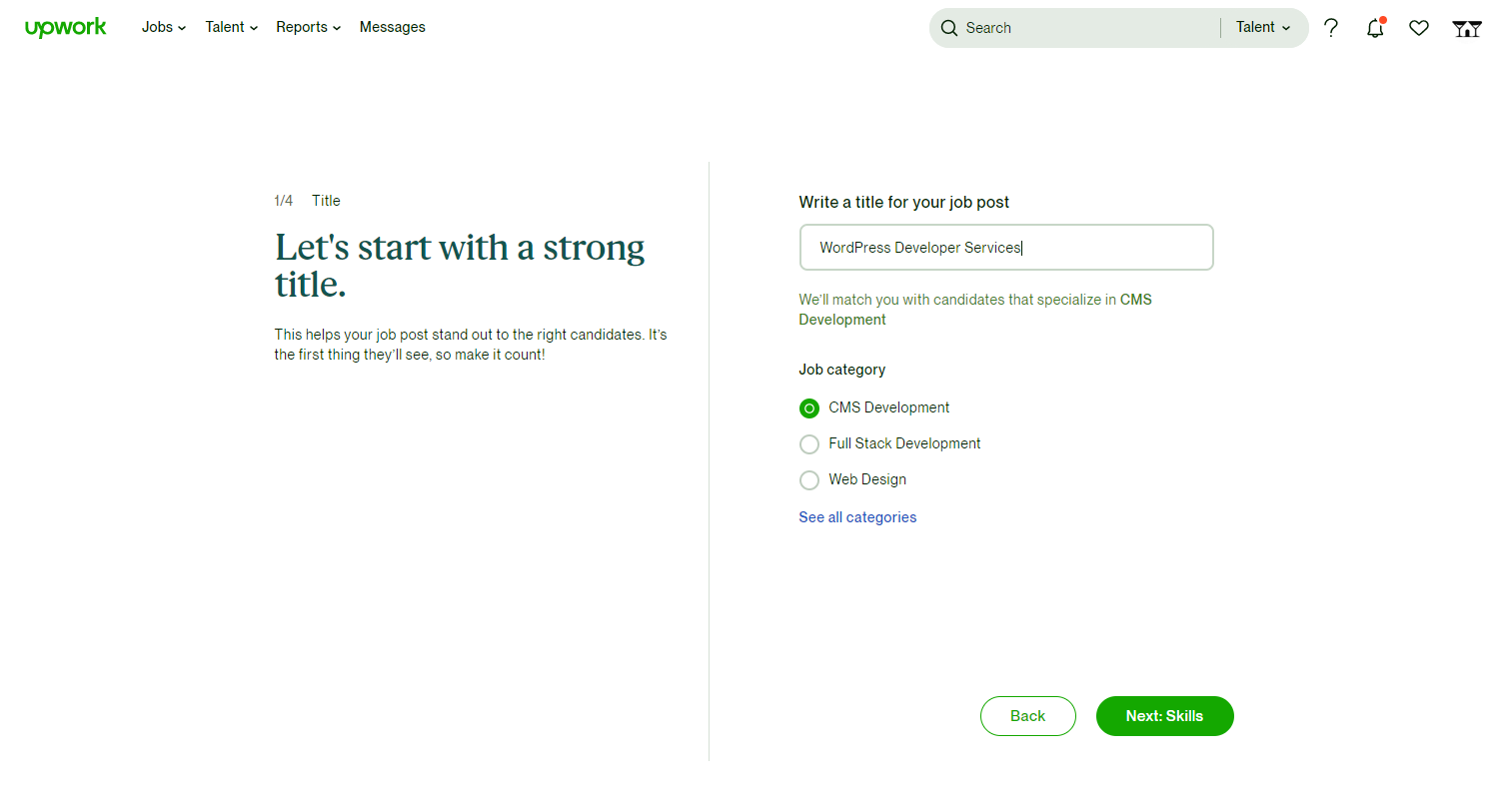
Official interface image from Upwork’s job-posting guide; the current account interface may differ. Select the image to open it at full size.
For help with wording, use the job-post example rather than copying a broad list of skills into your description.
4. Shortlist by relevance, then interview
Look for evidence that the candidate has worked on a comparable problem. Ask which part of a portfolio item they completed, which constraints mattered, and what they would need from you to begin.
Use questions that expose project assumptions:
- What would you clarify before estimating this work?
- Which dependency is most likely to change the scope?
- What would you deliver first so we can review the direction?
- What will we need to maintain after handover?
Compare answers against the brief, not against how confidently they are delivered. A candidate who identifies a missing requirement may be more useful than one who promises an immediate result without questions.
5. Choose the contract and confirm the total
Hourly work may suit discovery, maintenance, or changing priorities. Set a weekly limit and an update rhythm. Fixed-price milestones may suit a clearly inspectable output. Give each milestone its own deliverable and acceptance criteria.
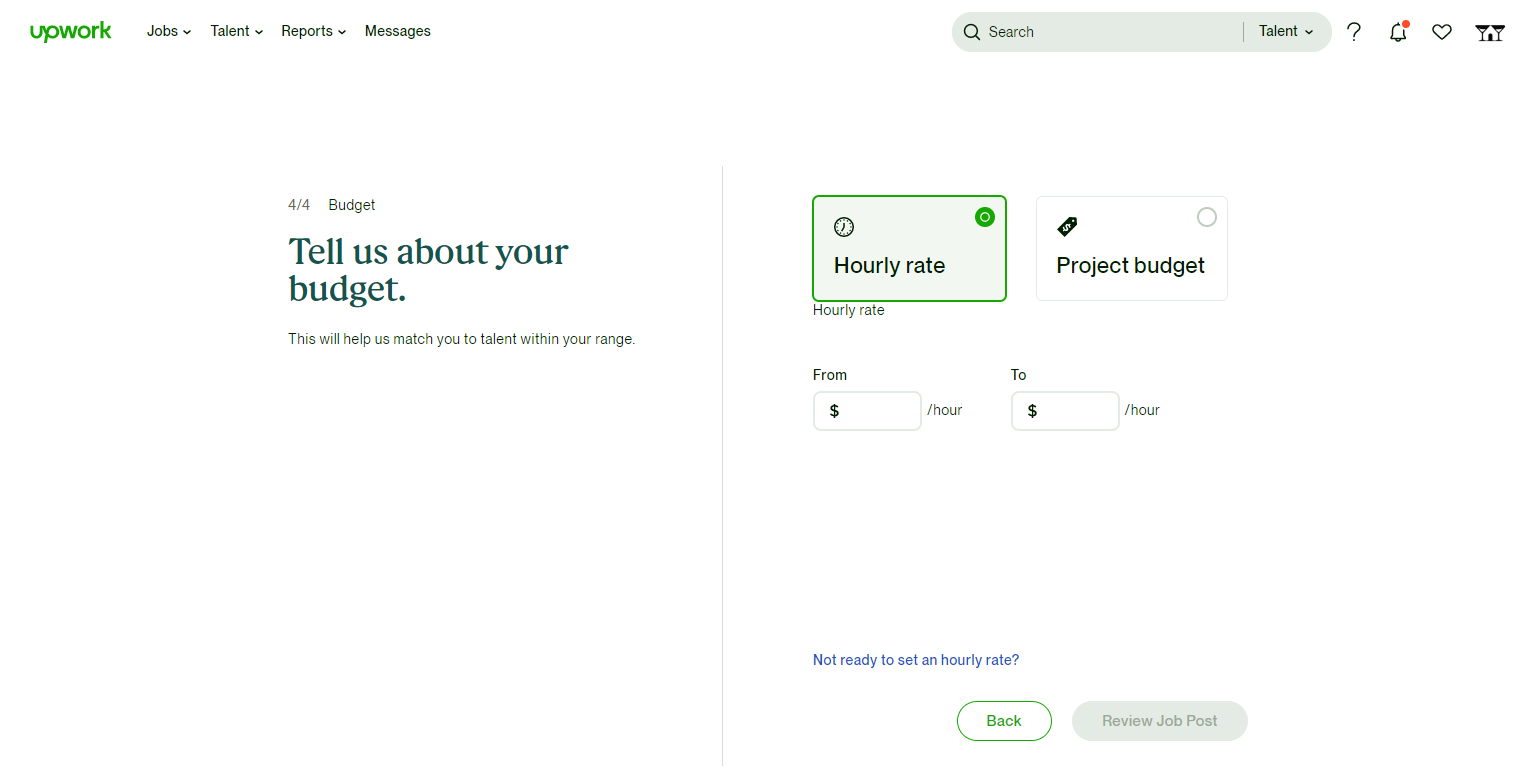
Budget interface image supplied in Upwork’s official guide.
Check the account’s fee breakdown before committing. Public Basic fee figures differ between the pricing and help pages; our Upwork fees article explains that discrepancy. A provider quote is only one part of the buyer’s total cost.
6. Start with a limited paid commitment
For a large or uncertain assignment, agree a paid discovery step or a small production milestone. Define what that step should establish. A technical discovery output might be a diagnosis, recommended implementation, and revised estimate, rather than a promise to solve every issue.
Keep the commitment fair to both sides. Do not ask several candidates to create the finished asset as an unpaid competition. Agree how the pilot output may be used and what happens if you decide not to continue.
7. Review work while the contract is active
Allocate time to inspect submissions and billing. Upwork’s payment documentation distinguishes hourly diary review from funded fixed-price milestones. It states that milestone funds can be automatically released 14 days after submission if the client takes no approval or change-request action.
The practical response is to assign an approver and schedule review time. If the work misses a written criterion, describe the gap precisely. “This is wrong” gives less direction than identifying the missing field, broken interaction, or unapproved wording.
8. Complete handover before expanding the work
Review source files, credentials, documentation, licenses, and open issues. Remove access that is no longer needed. Ask the provider to identify anything that depends on their personal account or a paid tool you do not control.
If the assignment will continue, record the new scope and how it differs from the original. Good repeat collaboration depends on clear expectations as much as the first selection decision.
Header photograph: Upwork homepage. All interface illustrations are official source images, not screenshots of a PrimeReview account.
Avoidable problems
Common buying mistakes
Choosing only by headline rate
A low rate says little about the number of hours, exclusions, or review effort.
Leaving acceptance undefined
A deliverable needs an observable completion test, not just a broad aspiration.
Optional next steps
Recommended Resources
These are resources to investigate, not a ranked list. A published guide should explain why each item is relevant.
Upwork
Use the prepared brief to compare relevant candidates and written offers.
Common questions
Frequently asked questions
Should I use a paid test project?
A small paid pilot can be useful when it has a defined output, agreed fee, and fair review criteria. Do not request substantial speculative work for free.
Should I choose hourly or fixed-price?
Consider hourly work for investigation or changing priorities, and fixed-price milestones for outputs that can be defined and reviewed. Agree limits and review responsibilities in either case.
How many candidates should I interview?
Use a manageable shortlist whose members have relevant evidence. There is no fixed number that guarantees a good hire; deepen the conversation where the project risk requires it.